

Library Reviews
OFF THE BEATEN TRACKS IN JAPAN
A JOURNEY BY TRAIN FROM HOKKAIDO TO KYUSHUU
A literati’s travelogue. It is a guide of sorts and starts at the northernmost station of Hokkaido and ends at a minor, unmanned station in Kyushu. Each station and locality along the way is discussed. Besides cuisines and sights there are lengthy digressions into history and cultural notes. Austere, sometimes grainy, black and white full page spreads ocassionally appear and reinforce that this isn’t a typical travel guide for precise itinerary construction.
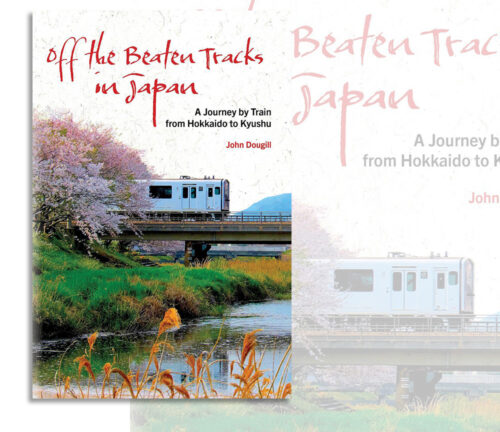
John Dougill is a master conversationalist. Never at a loss for some trivia, one anecdote leads to another, and an acerbic quip at the ready. Evocative of classic British comedy sketches, you can virtually hear the Yakety Sax background music as he describes fleeing across a campus from a yakuza. Then there’s the absurd chain of unhelpful assistance he receives after running his car off a deserted road in Akita. Arriving at his old stomping ground of Kanazawa is the excuse to regale of his earliest culture shock starting with spilling an onsen tamago over the cafeteria floor and finishing with a drunken priest introducing him at the local brothel.
It would be correct to perceive that many sequences aren’t strictly train related. Unlike some of his other works, which are more formal, here Dougill has free reign to veer at will between his favourite topics: history, industry, society and especially literary forebears. Isabella Bird, Donald Richie and Will Ferguson are constant mentions. Bashō‘s and other poetry are near fixtures. He visits Eiheiji, mentioning the famous salaryman who decided a year at the most ferociously hardcore temple would be a good break. It is a shame this lacks a reading list of the various books he refers to. Many of them, as well as Dougill’s other works are also available in the library collection.
EAT, SLEEP, SIT
Once upon a time, a Japanese salaryman forsook his comfortable career and the trappings of modern life to train as a monk. He chooses Eihei-ji; ancient, venerable and uncompromisingly strict. While monasteries and temples may conjure images of tranquillity and austerity, the indoctrination awaiting Eihei-ji initiates is harsh.
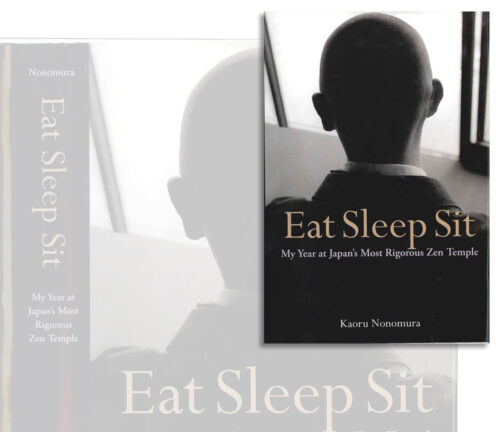
Eat Sleep Sit is Kaoru Nonomura account of his monastic sabbatical. Not just any monastery, Nonomura enters Eihei-ji, one of the two main temples for Soto Buddhism. Upon admittance he is transformed into Rosan and, along with eight other initiates, begins to adapt to a gruelling new lifestyle. Excommunication from the outside world and the shock of a technologically primitive environment are just the beginning. Corporal punishment, sleep deprivation, hard labour, starvation and, in some cases, hospitalisation are just some of the jarring revelations. Yet amidst the hardship, Rosan perseveres and becomes accomplished.
Although eye-opening, this book is by no means salacious or action packed. Early in the book, a Zen precept explains that “Monastic discipline is not something done in order to gain enlightenment; rather, the faithful observance of monastic discipline is enlightenment” (p38). Phenomenally detailed descriptions lay bare the dogmatic adherence to routine that pervades daily monastic life. Exacting rituals exist that govern mundane acts such eating, dressing, cleaning, walking and even going to the toilet. This book will no doubt please those readers curious about the minutiae of a monk’s life, but who understandably lack the tenacity or inclination to suffer the actual conditions first hand.
(Previously reviewed. Edited.)
JAPAN’S WORLD HERITAGE SITES
A magnificent tour of Japan’s World Heritage Sites. Packed with stunning photography and interesting reporting.
Most people could probably guess quite a few places from Japan that have attained World Heritage status. Mt Fuji, Himeji Castle, Itsukushima Shrine, The Peace Memorial at Hiroshima and the ancient parts of Kyoto are all Heritage listed. The surprise is discovering that there are a multitude of other places in Japan that are just as visit worthy as their famous brethren. The Iwami Silver Mine and surrounding district date from the 16th century. It once produced a sixth of the world’s silver and was marked by European mapmakers. Places that might not immediately be associated with Japan such as Yakushima island is home to thousand-year-old cedar forests. Even further flung are the Ogasawara Islands which are only reachable by a 25-hour boat voyage. This seclusion, and their as volcanic origin have contributed to unique subtropical flora and bird life.
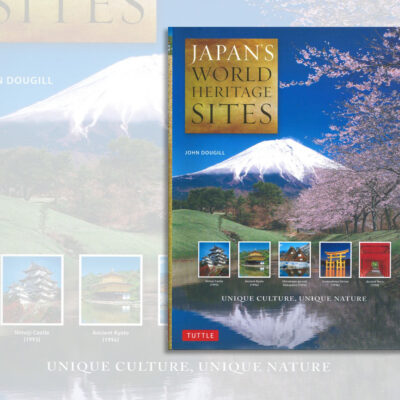
This book covers all 17 of Japan’s World Heritage Sites recognised at the time of writing. Compared to the international total, this number might seem oddly small. This is because a single World Heritage site can be just a single building or an entire city or region. In this manner, Kyoto is recognised as a single World Heritage site but itself consists of a further 17 recognised ‘properties’ such as the gold and silver pavilions, Ryoan-ji, and many others. Mt Fuji has 25 ‘properties’. Since the publication of this book, Japan has been successful in attaining World Heritage recognition of further sites, bringing the total to 26. Two of these additional sites, along with other candidates, are present in the appendix as nominees.
The status of World Heritage listing is awarded to cultural or natural places throughout the world that have been recognised as being of universal value to the heritage of humanity. UNESCO (a special agency of the United Nations) has maintained the list since its inception in 1972 and there are over 1000 sites.
(Previously reviewed. Updated.)