


Library Reviews
ISHIRO HONDA – A LIFE IN FILM, FROM GODZILLA TO KUROSAWA
STEVE RYFLE and ED GODZISZEWSKI with YUUKO HONDA-YUN
The most prolifically screened Japanese film director for international audiences until Hayao Miyazaki…
Director Ishiro Honda was a seminal force behind the kaiju eiga sub genre, or giant monster movie. His most famous film, Gojira, achieved iconic status worldwide. Following movies in similar vein, would burnish his international box office popularity. Whilst so doing, his output achieved the cultural distinction of introducing, particularly to US audiences, entirely foreign, non-European environments and ways of life.
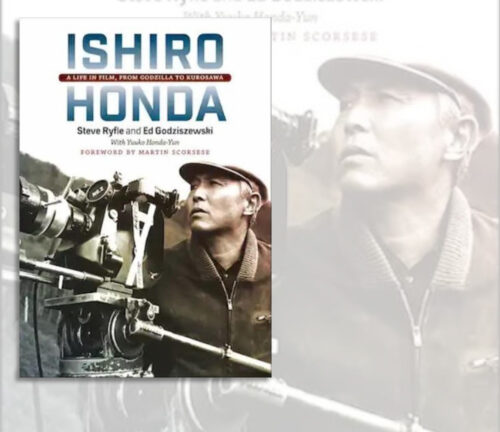
Comparatively though, Honda’s esteem amongst mainstream cinephiles is less than that accorded to other Japanese film making luminaries. An eminent example being his contemporary, Akira Kurosawa. The two men were friends, colleagues and collaborators. Their mutual respect for one another not paralleled by the popular respect accorded to their legacies. Fellow auteurs were far more appreciative of Honda’s filmmaking perhaps due to understanding the industrial realities leading to the corrupted localisations or diluted effects. Tim Burton was particularly complimentary of Honda’s films in their native form.
In spite of a textbook-like appearance, this biography has a novelistic style. It primarily retraces Honda’s life with respect to his career and liberally integrates anecdotes and revealing moments. Underappreciation of Honda’s work is explained as due to being somewhat professionally unfortunate in several ways. Still, it could be argued this luck was offset by a war incident when a mortar shell landed in front of him but did not detonate. Honda ended up claiming the shell as a memento of his lasting military trauma.
WAITING ON THE WEATHER: MAKING MOVIES WITH AKIRA KUROSAWA
TERUYO NOGAMI
If the name of Akira Kurosawa is synonymous with the best of classic post‑war Japanese film‑making, then this autobiography, by one of his most constant and closest collaborators, provides a candid counterweight to the process of creating a masterpiece.
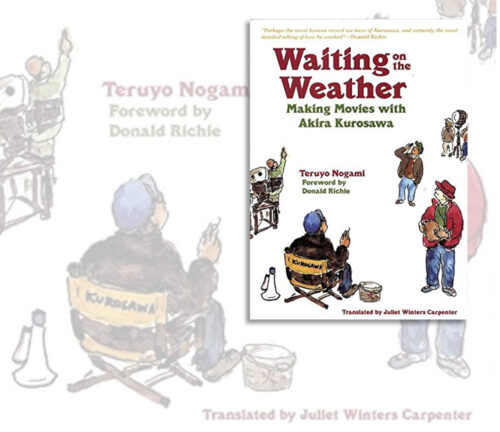
This book is authored by Teruyo Nogami, Kurosawa’s long‑time assistant. Her association with Kurosawa began with Rashomon in 1950, initially as a continuity assistant or ‘script girl’. The relationship extended throughout the rest of the century with her eventually serving as production manager.
Written with candour and without pretention, Nogami’s anecdotes provide the unseen, sometimes inglorious but often fascinating realities to the minutiae behind Kurosawa’s films. The mix of memories include being on the receiving end of a bowl of gruel hurled by Kurosawa, the dichotomy of a tiger costing more to feed than the income of the director himself, and the pest infested Siberian forest that necessitated the film crew perform tick inspections on each other (replete with illustration).
(Previously reviewed.)
EIJI TSUBURAYA: MASTER OF MONSTERS
Master of Monsters covers the career of Eiji Tsuburaya and the early days of special effects that yielded Godzilla and Ultraman. While the effects themselves can’t compare against 70 years of progress and CGI, this is still a fascinating trek behind the scenes of a defining period in film history.

In Japan, Eiji Tsuburaya is known as the god of special visual effects. In the Western world he is mostly preceded by his iconic creations. Drawing inspiration from King Kong (1933) Tsuburaya embarked on genre defining efforts that would eventuate in the kaijū eiga (giant monster movie) becoming enduringly associated with Japan. This book provides a detailed look at several of the films Tsuburaya worked on and the innovations and contextual events during production.
Tracing Tsuburaya’s film industry career is akin to a walkthrough of early special effects technology in Japan. He started as an assistant cameraman and would become recognised for bringing a dynamic quality to his camerawork. Many stock techniques of today such as slow motion, double exposure and matte backgrounds were pioneering concepts during Tsuburaya’s time and required him to learn from trial and error. He experimented with alternative lighting and the use of smoke pots on the set. A cultivated predilection for tinkering served in good stead when he developed a mechanical camera crane. A descendant of his design is still in use around the world today.
Tsuburaya’s career was not predestined by any definition. Although exhibiting artistic and academic ability at an early age, he was also born into an affluent and somewhat aristocratic lineage. He was precociously inquisitive and particularly captivated by planes and flight. At varying times in his pre‑cinema life he would attend a flight school, study engineering, be drafted into national service and almost inherit the onerous task of running the family business.
(Previously reviewed 2011 April. Edited.)