


Library Reviews
DREAMING JAPANESE
Superbly authored life story of a rock superstar charaterised by nostalgia and reinvention. Multi spectrum appeal for Marty Friedman fans, metal heads, musicologists, historians and foreign residents of Japan.
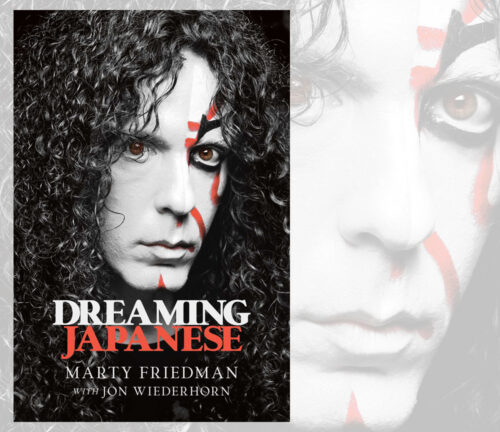
The book opens with Friedman already well along in his mid-life renaissance in Japan. His established professional and critical recognition more than survived the transition. What weighs acutely on him is awareness of a sense of separation and lack of social belonging when around native Japanese. A sentiment commonly echoed by many emigrants.
Marty’s story consists of a comfortable childhood, a guitar-propelled adolescence, years of sojourning, an integral tenure during Megadeth’s apex period and then gradual relocation to Japan. His musical development often integrated or parallel with nonchalant debauchery. There’s a resonating dissonance in which chaotic life events are divulged in an expertly curated manner. Probably indispensable to this transformation of anecdotes into a vividly fluent narrative was Marty’s co-writer, Jon Wiederhorn, a veteran rock industry journalist.
Dreaming Japanese encompasses some related but discrete areas of interest, of which the actual Japan portion is probably no more than half. There’s insight into the admin tribulations of band work and relationships within an industry-defining supergroup. Only musically educated readers could appreciate special nuances such as the difficulty of successfully singing over time signatures that abruptly shift from 9/16 to 5/4. Understanding Marty happens literally and also by inference or omission. Though unstated, his exploits require a genius level intellect. He’s able to recall incidental details of even non-pivotal moments which imparts them with an authentic lucidity. At other times, he seems happily unaware of his own tropes and prejudices.
BODERLINE JAPAN
A sweeping look at ground level experiences of immigrants and foreign residents in Japan during the middle of the 20th century.
Borderline Japan examines the creation of Japan’s contemporary migration and border control system and the nature of Japanese society itself. Focus is placed on the actions and experiences of individuals and the repercussions of contemporary prevailing policy at ground level. Heightened border crossings also tend to cascade from upheaving historical events such as the post war occupation of Japan, the Korean War and the Cold War. Also evident are the lasting effects of the distant but seminal Japanese colonisation of Taiwan and Korea.
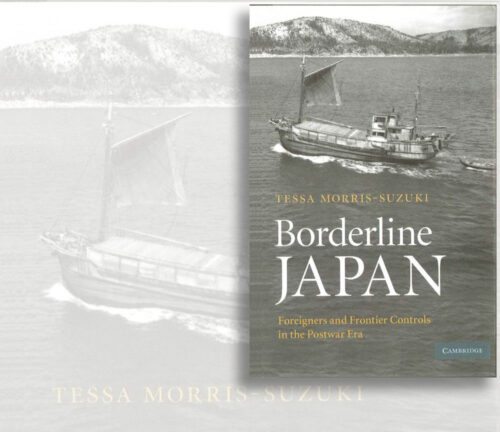
As mentioned earlier, author Morris-Suzuki’s work emphasises the personal experiences of both “foreigners” and the frontline state representatives who carried out official policy. Some examples of the personal situations covered include the fact that there were no official provisions for Koreans, who had settled in Japan to legally, to visit their homeland. Another would be the nebulous status of foreign (US) military personnel and deserters. Political volatility between and within China, Taiwan, North Korean and South Korea created a convoluted situation when it came to nominating one’s country of origin and also for authorities in determining which national body to liaise with. Macroscopic conditions that affected official policy are also examined (such as the shifting post war border demarcations and the diplomatic ramification of competing national governments in China and Korea).
Omura Immigration Detention Centre, now Omura Immigration Reception Centre, features prominently towards the second half of the book. Opened in 1951, it is now one of longest lived migrant detention centres in the world. Consistent with the rest of the book, the evolution of the detention centre is frequently conveyed by the experiences of detainees and other individuals who operated or otherwise interacted with it.
(Previously reviewed. Edited.)
THE KINGDOM OF DREAMS AND MADNESS
Luminaries like director Hayao Miyazaki and producer Toshio Suzuki feature prominently in this intimate, far-ranging look inside the Studio Ghibli office.
Studio Ghibli has consistently produced animated films regarded as amongst the most beloved and influential. This documentary goes inside their office compound which is situated on an almost suburban block in Koganei, Tokyo. Unlike its famous museum in Mitaka, this enigmatic corner building is not open to the public and has been home to Ghibli since 1992.
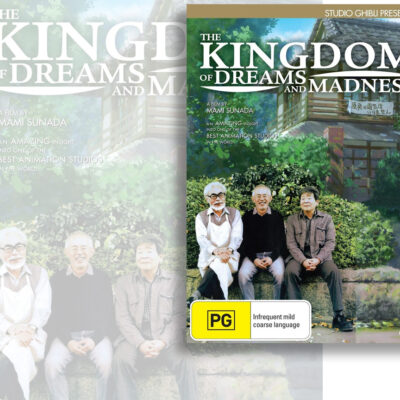
Most of the program consists of interaction with studio personnel in their workspaces and candid recordings of work meetings. Senior staff, Hayao Miyazaki and Toshio Suzuki are prominent. The former is featured extensively. Besides work discussions, we watch Miyazaki do radio calisthenics, visit his atelier, observe his adopted flock of toy goats that he brings in at the end of the day like laundry. There is old company home video of a young, pre-beard Miyazaki singing karaoke. There is new footage of an old Miyazaki climbing a tree.
Filmed in 2012, it is very much encapsulates its time. The matters occupying Ghibli were its forthcoming films: The Tale of the Princess Kaguya and The Wind Rises. The overshadowing event was the 2011 disaster a year earlier. Naoto Kan’s campaign van can be heard in the background of one scene. Isao Takahata was also still alive. Despite being in the cover photo and frequently mentioned, even Goro Miyazaki is seen and heard from more than Takahata who is barely a cameo appearance. Overall the program manages to be light-hearted but informative. Probably summed up in the sequences where fellow superstar director Hideaki Anno is hauled in and conscripted as the lead voice in The Wind Rises.
Ushiko Investigates
One of the specials of this DVD is a featurette on/by the resident office cat, Ushiko. At least at first. It is 30 minutes long. What transpires are some edits that were presumably cut from the main program but too good to go unseen. Yoshiaki Nishimura, at the time still with Ghibli, expands on some of the tension hinted at in the main feature. There is a visit to Ghibli by former Pixar and Disney heavyweight, John Lasseter. This is followed by a sequence covering esteemed composer, Joe Hisaishi. A notable omission from the main feature, Hisaishi’s involvement with The Wind Rises is obviously the score but begins with a scene of him visiting Studio Ghibli for a small party and birthday cake with Miyazaki.
(Previously reviewed. Edited.)