


Library Reviews
HOOKED
ASAKO YUZUKI translated by POLLY BARTON
Neurotypicality has left the room.
A kind of black comedy with odd couple energy. It starts out like a relationship drama, of the platonic kind, between two ladies edging middle age. One a dowdy, married, refreshingly lazy blogger (remember those?) and the other her unlikely superfan: an attractive, high achieving corporate career girl. A midway rug pull is when the fun kicks in and when various characters start crashing out. It seems that once the bastion of normalcy is breached, much neurosis manifests. For all the antics though, and even with a setting now a decade removed, at least one theme is still as pertinent: we share more than ever but how real is anything and why is there so much loneliness?
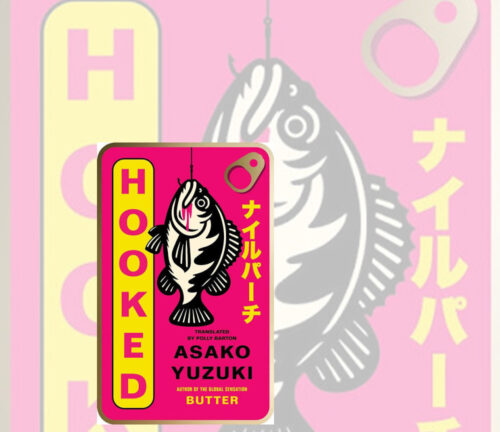
Hooked is the retitled English edition. Understandable as the Japanese title ナイルパーチの女子会 means something like Nile Perch Girls’ Gathering or Girls’ Association. The Nile Perch are an invasive fish species that are infamously effective at predating their ecosystem clean of smaller endemic fish. Cover art has also changed. The Japanese original featured a dreamy, pastel like watercolour of two, whimsically waifish girls holding hands. All rendered in a mostly pale, neutral palette. The only oddity being the oversized fish in the background. No such subtlety on the English edition which goes all out on lurid, high-contrast that complements the punchier title.
SHINTO SHRINES
JOSEPH CALI with JOHN DOUGILL
Over 80,000 shrines are thought to be found in Japan. This guidebook highlights 57 of them based on spiritual or historic significance, the beauty of their surroundings, architecture, uniqueness and popularity.
No exact count exists for all the shrines throughout Japan. Most are modest and can vary from being partially forgotten to being a celebrated site with national or World Heritage recognition.
The bulk of this book is given to shrines that have been identified as noteworthy by the authors. Elements common to travel guides are present; typically consisting of notes on transport, contact details, and the like. Dense information is provided on the spiritual and historical details of each shrine. Information for each specific site also includes the particular kami (god/spirit) that inhabit the shrine and a description of closely associated festivals.
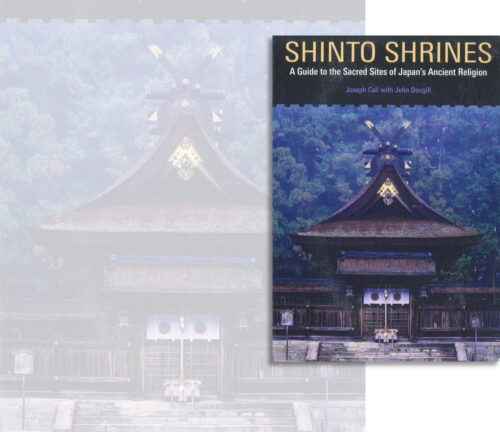
Besides the reviews of specific sites, the beginning of the book has 50 odd pages introducing Shinto. The earliest histories of Japan are comparable to the Old Testament or Ancient Greek mythology and Shinto is entwined. Besides ancient history, the beginning section also explains basic modern concepts of visiting shrines and what “deities” or kami exist. Commonly recurring architectural elements found in shrines and ceremonial objects are also illustrated and explained.
Shinto, together with Buddhism, constitute the spiritual beliefs that most Japanese associate with. This is probably also consistent with what most non-Japanese perceive of religious affairs in Japan. However, as noted by the authors, many Japanese are ambivalent towards religion and do not strongly identify themselves as adherents of a faith. Many Shinto practices and customs have become so interwoven into society that they have moved beyond their original religious roots. Particularly the cornucopia of matsuri (festivals). The authors have likened this to the manner in which Christmas festivities and present giving have become a secularised activity which even non aligned or non religious people participate in and enjoy.
(Previously reviewed. Edited.)
YASUKE – the true story of the legendary African samurai
THOMAS LOCKLEY, GEOFFREY GIRARD.
It’s 1579 and the end of Japan’s warring age appears imminent. Few warlords remain who have not been crushed or enthralled by the might of Oda Nobunaga, the great unifier. Making inroads are firearms, European fashion and Christianity. Into this world steps Yasuke, a towering, dark skinned African bodyguard who ascends to Nobunaga’s inner circle. More than a biography, this is a detailed account of martial, upper echelon, pre–Edo Japan.
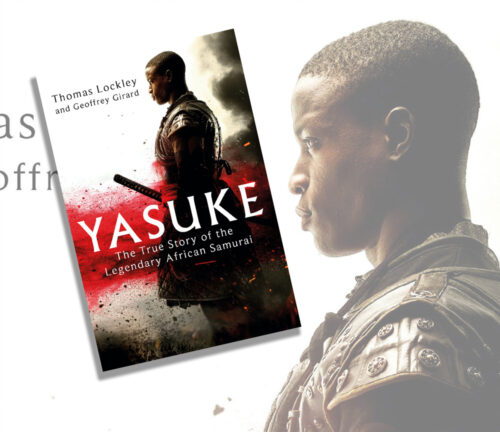
Taking place amidst some of the most exciting and violent years of Japanese history, this is a riveting textbook camouflaged as a biography. Yasuke was an intriguing oddity. A singular black African soldier, he arrived at a time when Europeans were rare and himself nearly unique. He rose to become a confidant of the most powerful warlord the country had seen and officially gained elevation to samurai station, complete with stipend and household. He’s also a linguistic genius going from fresh off the boat, barely even heard of Japan, and within a year he is conversing with the defacto head of state. Not only without embarrassing himself but well enough that Nobunaga would specifically seek him out for discourse.
Yasuke’s story is the backbone to two other major elements that contribute to the bulk of the 400 pages of content. Digressions are frequent and sometimes expansive. These cover relevant character backstories, the state of the world, the Jesuit order, scientific advances, ocean travel, regional history, local history, cultural notes and other circumstantial information. The other major element is Oda Nobunaga. His looming presence and monumental impact mean that Yasuke is sometimes an excuse for a massive infodumping of Nobunaga’s manoeuvrings, political intrigues, regional factions, personal histories and warfare. This last point is not to be taken lightly. Another review goes as far as saying that “blood and gore ooze from the pages.” Perhaps an exaggeration but it does viscerally convey the martial activity prevalent to Yasuke’s world.
Yasuke is the work of Thomas Lockley of Nihon University College of Law, Tokyo, in collaboration with Geoffrey Girard. Described by some sources as a debut novel, it certainly feels as if great care and attention have been lavished into its details. It was first published in 2019 as African Samurai. Arguably a much better and very literal title but perhaps confusable with the separate cult fiction property, Afro Samurai. The latter being an action slasher in a generic Edo-ish setting with light cyber and supernatural genre blending. More recently, an older, fictionalised Yasuke stars in a Netflix OVA adaptation, again featuring an altered history and very anachronistic Edo.
(Previously reviewed. Edited.)